Article
Inflections: A Long-Term Framework for Investing in an AI World
31 July 2026
Since November 2022, when OpenAI first made ChatGPT 3.5 publicly available, AI has become the dominant force in financial markets, generating outperformance across a wide range of public and private equity market sectors. Much of this has been based on expectations for sustained, exceptional earnings growth. The key questions facing investors are: 1) How much further upside is justified by fundamentals, as opposed to sheer momentum, and 2) Where will any future gains lie?
In this note, we share a refreshed view of the current context, which helps inform the key longer-term parameters. We then provide a framework for assessing the likely long-term implications of not one, but four scenarios in which AI becomes prevalent as a General Purpose Technology (GPT)1. We also consider the macro and investment implications of each scenario.
What explains recent AI-related market inflections?
There have been three successive waves of sectoral market shifts linked to AI over the last few quarters. First, the aggregate software sector, broadly seen as being subject to disruption, began its decline in October 2025. That index is now down c. 30% from its October peak and down 20% YTD,2 even if pockets have outperformed. Second, hyperscalers, until recently an AI beneficiary, are down c. 19% from their 1 June peak and down 11% YTD.3 Third, the semiconductor sector,4 a key data center buildout beneficiary, has declined c. 20% from its 22 June peak, although it is still up 67% YTD.
Clearly, there are wide variations within the indices and some of these declines may be simple consolidation after heady gains. However, there are also clear warning signs:
- Hyperscaler free cash flow is being consumed by ever increasing capex forcing capital markets to make up the difference. Until now, a key distinction between the AI and dot-com eras was that the AI buildout was primarily financed by free cash flow (FCF) rather than through leverage. Hyperscaler FCF peaked at c. $400B in early 2024 and has since declined to near zero5 as the cumulative 2026-2028 capex guidance has increased to c. $4T.6 Hence, these companies have been increasingly forced to turn to debt and equity markets for financing. Hyperscalers have issued more than $200B of investment grade debt in H1 2026 (10% of all global investment grade issuance YTD), roughly double their issuance for 2025.7 The $85B Alphabet (Google) equity raise in June to fund AI infrastructure costs was the first time it issued equity since its $2B raise in 2006 and is on par with the recent SpaceX IPO.
Hence, a necessary, but not sufficient, condition to achieve a satisfactory return on this massive capex outlay will be that these models ultimately deliver significant productivity benefits for end users over the longer term. - Open-weight models are narrowing the gap relative to closed frontier models. The performance gap with the frontier models is diminishing rapidly but token costs remain much lower. On 16 July, Chinese lab Moonshot AI released Kimi K3, a 2.8-trillion-parameter model that took first place on the Frontend Code Arena, a leaderboard scored by blind developer votes on the web apps models generate. K3 reached 1,679 points, ahead of the closed flagships Claude Fable 5 and GPT-5.6 Sol, and led six of the seven frontend categories. Additionally, business continuity and data security concerns associated with relying primarily on remote closed models are rising to the forefront. Anthropic temporarily withdrew Claude Fable 5 on 12 June, due to a US government export-control directive citing national security concerns over a potential bypass. On 24 June, a group of more than 20 US tech companies including Microsoft, Palantir, NVIDIA, Meta and Hugging Face signed a letter urging policymakers to avoid restrictions on open-weight models. Ultimately, whether model providers capture a meaningful share of the economic value created – and thus avoid commoditization – will largely depend on how quickly they can accelerate performance improvements per unit of token cost.
Introducing a Longer-Term AI Framework
As previously noted, we believe AI will ultimately evolve into a General Purpose Technology (GPT). Economists define a GPT as an innovation important enough to reshape how an entire economy produces and invents, rather than one confined to a single industry. The time it takes for these GPTs to become widely adopted (their diffusion cycle) varies greatly. Several examples of past GPTs, and the length of their diffusion cycles, are listed below:8
- Canals (UK, c. 1760s–1830s): took roughly 50–70 years to spread from early works like the Bridgewater Canal (1761) to a mature national network.
- Steam power (from c. 1770s, Watt’s engine): diffusion stretched over a century, not reaching full industrial saturation until the mid-1800s.
- Railroads (from 1830, Liverpool–Manchester line): spread much faster – roughly 30–40 years to blanket most industrialized economies.
- Electricity (commercialized c. 1880s): took about 40–50 years for factories and households to fully adopt, with productivity gains only clear after WWI.
- The internet (public from early 1990s): reached broad global use in roughly 20–25 years, aided by faster complementary infrastructure (PCs, mobile).
There are two recurring patterns among GPTs. First, despite the massive economic value created by these technologies, as adoption matures, much of the economic rent tends to accrue to the users of GPTs, rather than to the suppliers. Second, the productivity benefits will be generated by some mix of labor cost savings and output expansion. Over the longer term, output expansion tends to dominate labor disruption. However, in the early stages of GPT adoption, the opposite of both the above effects may occur. Below, we apply these two dimensions to build a long-term AI framework.
- Commoditization: Open vs Closed Models
In terms of who captures the economic value, much will depend on the degree to which the models are open versus closed weight. A shift toward lower-cost open weights should increase overall token demand (Jevons Paradox) thus increase the size of the addressable market. However, as with previous technological breakthroughs, the current cohort of AI providers will not necessarily benefit from the future demand.
Supply capacity is expanding in many countries as “AI Sovereignty” is increasingly cited as a strategic priority. China is investing heavily in developing its own full ecosystem, including recent advances in lithography, combined with exploiting its large electricity supply, estimated at over 2x the capacity of the US. Ultimately, we believe that although open-weight models will likely dominate, there will likely be a place for both premium and open-weight models, similar to other industries (e.g., automotive) where a minority share of the market goes to the premium/higher-end suppliers. - Productivity: Output boost vs labor force destruction
Similar to the past consequential technological advancements transforming the global economy (e.g., canals, railroads, telecommunications, internet, etc.), we believe AI will ultimately generate significant productivity gains, much of it driven by increased output rather than by a shrinking labor force.
Already, we see examples of this. In the field of life sciences, the use of AI is increasing the scope of applications in drug discovery, diagnostics and clinical operations. In the tech world, despite signs of labor displacement in certain segments (internet platforms and SaaS), other companies such as Nvidia are increasing their overall hiring levels as AI-driven chip design opens up new markets and applications.
However, the road ahead will likely be bumpy. A key difference with past GPT technologies is that the ever-shrinking diffusion cycle may leave less time to repurpose the labor force. At the turn of the 20th century, about 40% of the US labor force worked in agriculture.9 Today, over a century later, that figure is around 1.5%10 with a lower estimated unemployment rate. Given a far more accelerated diffusion cycle, the early stages of AI adoption may prove more disruptive to the labor force, creating social and political pressures along with disinflation.
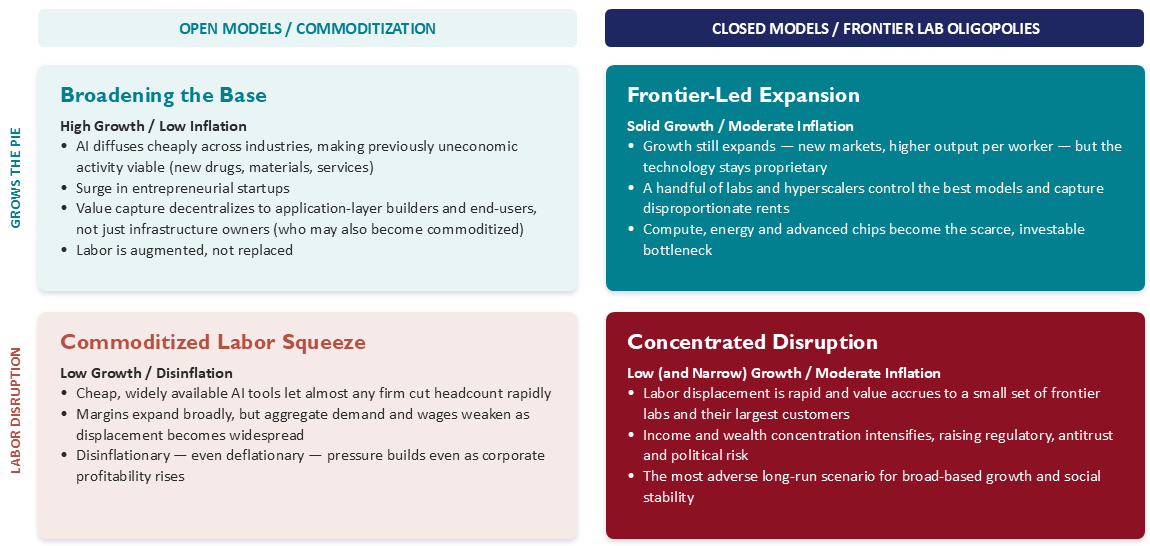
Putting the above two dimensions into the matrix below (Exhibit 1), we highlight the macro and investment implications in each scenario.
Exhibit 1: Long-Term Outcomes – General Purpose Transformative AI is Not a Single Scenario
Source: Partners Capital Analysis.
Scenario Details and Investment Implications
If the pattern of previous GPTs holds, an outcome closer to the top left scenario of more commoditized models and output led productivity gains becomes more likely over the longer term. However, in the short term, we may pass through other scenarios before we get there. As diffusion cycles shorten with every new GPT, there is less time for the labor force to reconfigure and address the newer skill sets required. Hence, the lower quadrants of labor disruption become more likely. Separately, if the frontier models manage to widen the gap again vs the open weights (e.g., through better recursive learning) or if the open-weight providers decide to close their models (as did OpenAI), then we might move to the right-hand side of the matrix, at least in the interim.
From an investment perspective, we expect the following overarching principles to hold across scenarios:
- Every investment manager should be thinking deeply about these issues
- The AI infrastructure build is likely to persist for the foreseeable future
- Power generation and supply is likely to be an enduring theme across scenarios
- Portfolio resilience remains paramount – investors should hold some level of diversified exposures across scenarios
- Maintain allocations to less correlated assets such as Absolute Return, particularly those able to navigate a rapidly shifting macro environment
As always, we will continue to monitor the rapid and ongoing developments in this area and keep you updated as our thinking evolves.
Sources
- OECD: “Is AI a General Purpose Technology” June 2025
- S&P 500 Software and Services Index – all data from Bloomberg as of 24 July 2026
- UBS Hyperscalers Index
- Philadelphia Semiconductor Index
- Bloomberg
- I/B/E/S
- Goldman Sachs
- Bresnahan, T.F. & Trajtenberg, M. (1995). “General Purpose Technologies ‘Engines of Growth’?” Journal of Econometrics, 65(1), 83–108; Helpman, E. & Trajtenberg, M. (1998) “Diffusion of General Purpose Technologies.” Jovanovic, B. & Rousseau, P. (2005). Survey chapter on GPT macroeconomics (in Handbook of Economic Growth); Lipsey, R., Carlaw, K., & Bekar, C. (2005). Economic Transformations: General Purpose Technologies and Long-Term Economic Growth, Oxford University Press
- U.S. Census Bureau. (2007). Annual Average Number of People Employed in the Agricultural and Nonagricultural Labor Forces in the United States
- 1900–1970. USDA Economic Research Service. (2025). Farm Labor topic page, citing BLS Quarterly Census of Employment and Wages (QCEW)